B2B Rocket
An AI sales platform needed a website that behaves like its product: fast, measurable, and built to book demos.
- Client
- B2B Rocket, a Black Pearl Group brand
- Industry
- B2B SaaS, AI sales automation
- Timeline
- 7 weeks, launched Aug 2026
- Scope
- 34 pages, 3 CMS collections
- My role
- Webflow development on Client-First, CMS architecture, GTM and first-party tagging, technical SEO and AEO
The challenge
B2B Rocket sells AI agents that prospect, engage and book meetings on their own. The website had to make that promise credible in about ten seconds, and it wasn't managing it.
The old site had grown a page at a time over two years. Styles had drifted between sections, the navigation no longer described the full product suite, and every content change came back to a developer. Mobile performance sat in the fifties. In AI answer engines, which by 2026 carry a real share of B2B software research, the brand barely appeared at all.
The rebuild also had a constraint that ruled out starting from a blank canvas: dozens of product and blog URLs were already ranking, and linked from G2, Product Hunt and partner sites. Nothing could be allowed to drop.
What the brief had to deliver
- Product-led design that shows what the AI agents do, rather than describing it
- A class system that keeps working as new product and solution pages are added
- One primary conversion — book a demo — with qualification built into the form
- First-party tracking, so marketing can attribute pipeline by channel
- Visibility in Google AI Overviews, ChatGPT, Perplexity and Gemini
- Zero ranking loss through the migration
Design approach
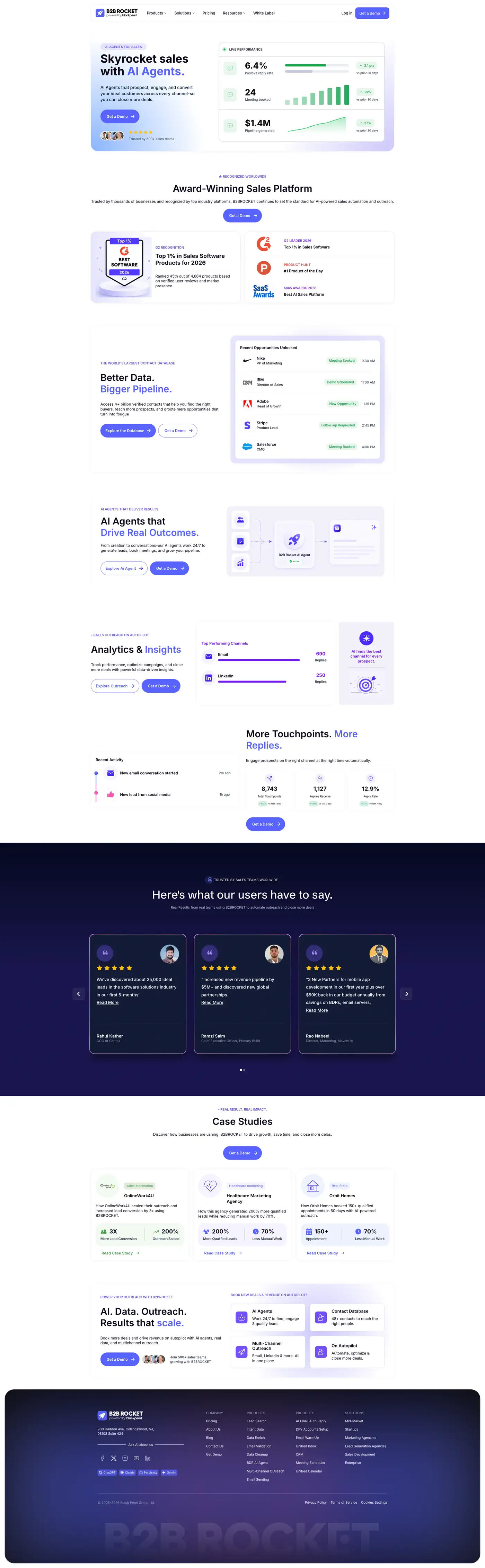
The fastest way to make an AI product believable is to show its output, so the homepage borrows from the product itself rather than from stock illustration. The first viewport carries the same blocks a customer sees after logging in.
Around that, the page stays deliberately quiet. A light interface with a single indigo accent reads as enterprise software rather than a startup landing page, and it lets the dashboard blocks carry all the visual weight.
Proof arrives early, inside the first two screens, and a dark testimonial band midway down resets the rhythm before the case study cards — which are built around the numbers clients care about rather than around logos.
Every section ends at the same destination. Get a demo opens a modal that asks for team size and revenue band, so sales receives bookings that are already qualified instead of a raw calendar invite.
What the first two screens show
- Live performance cardPositive reply rate, meetings booked and pipeline generated, each against the prior 30 days
- Opportunities unlocked feedNamed accounts moving through booked, scheduled and follow-up states
- Channel analyticsWhich channel is producing replies, and where the AI is shifting spend
- Proof bandG2 Top 1%, Product Hunt #1, SaaS Awards 2026, 500+ sales teams
The Webflow build
The site is built on Finsweet's Client-First, which was the deciding factor for a team that plans to keep shipping pages. Global structure classes hold the layout together across all 34 pages, so a new page inherits the right rhythm before anyone touches it.
Page-specific classes live in their own folders, which means the Designer panel reads like documentation. Any Webflow developer can open the project and find their way around without a handover call.
Spacing and type run on a rem-based scale, so one edit on the style guide moves the whole site, and everything that repeats is a component, built once.
The other half of the build was weight. Between WebP and AVIF exports, correct sizing and lazy loading below the fold, the homepage went from 3.4 MB to 1.1 MB. That single change is what moved the mobile score, more than any other optimisation.
How the class system is laid out
- Global structure
page-wrapper·padding-global·container-large·padding-section-large - Page folders
hero_·awards_·testimonial_·case-study_ - ComponentsMega-menu navbar, footer, CTA banner, testimonial slider, demo modal, case study card
- BreakpointsDesktop, tablet, mobile landscape and portrait, all checked before handover
CMS and publishing
Three collections cover everything the marketing team publishes, each with category references. More than 140 existing items were migrated with their slugs preserved, which is what kept the redirect map small and the rankings intact.
The useful part is what happens after publishing. A case study tagged with its category flows into the homepage grid on its own, so a new customer story appears on the front page without anyone opening the Designer.
In the first month after launch the team published nine blog posts and two case studies, and raised no developer tickets to do it.
Collections
- BlogCategory references, author, reading time; feeds the resources hub and the related-posts strip
- Case StudiesResult fields render as the big numbers on the card, and flow into the homepage grid automatically
- NewsroomPress and product announcements, kept separate so they never dilute the blog
- Migrated140+ items moved across with slugs preserved
Tracking and data
Marketing was flying half blind. Browser privacy features and ad blockers were quietly dropping a slice of every campaign's data before it reached GA4, which made channel attribution an argument rather than a report.
Google Tag Manager now ships site-wide through project custom code, but the tags are served from a first-party subdomain, load.gtm.b2brocket.ai, through server-side GTM. That one change recovered roughly a fifth of the sessions client-side tagging was losing.
On top of it sit twelve custom dataLayer events covering the whole demo journey, from the first CTA click to the confirmed booking. Consent Mode v2 is wired to the cookie banner for EU traffic, and conversions forward to GA4, Google Ads and LinkedIn Campaign Manager, so each channel is judged on bookings rather than clicks.
dataLayerlive
- page_viewpath: /
- cta_clicklabel: get_demo · section: hero
- demo_modal_opentrigger: cta
- form_field_completefield: company_size
- demo_form_submitrevenue_band: 25k_50k
- calendly_bookedvalue: 1 · currency: USD
- scroll_depthpercent: 75
- case_study_clickslug: orbit-homes
SEO and AEO
Getting found by Google
The migration came first. Sixty-four legacy URLs were mapped to 301 redirects and verified in Search Console before launch day, which is the whole reason organic traffic held flat through week one instead of dipping.
After that it was fundamentals, done on every page rather than on the important ones: unique titles and meta descriptions, Open Graph and Twitter cards, a single H1 with a real H2/H3 hierarchy beneath it, keyword-based slugs on all product and solution pages, and schema for Organization, SoftwareApplication, FAQPage and BreadcrumbList.
Getting quoted by AI assistants
Ranking is no longer the only way buyers find software. A growing share of research starts in ChatGPT or Perplexity, and those systems quote pages that answer a question plainly and name things consistently.
So the copy is written to be liftable: direct answers, one idea per paragraph, the same entity names throughout. An llms.txt file at the root points crawlers to the canonical product pages, and FAQ blocks on product pages are marked up properly, because they are genuinely on the page.
The footer carries an Ask AI about us module that opens ChatGPT, Claude, Perplexity or Gemini with a prompt already filled in, asking it to read and cite b2brocket.ai.
Performance
Lighthouse on mobile, median of five runs on the homepage, measured after launch. The old site scored 54.
Almost all of the gain came from weight rather than from clever tricks: right-sized images in modern formats, lazy loading everything below the fold, and no render-blocking third-party scripts in the head.
Core Web Vitals moved with it. LCP dropped from 4.2s to 1.6s, and layout shift went from a visible 0.18 to effectively nothing once every image carried explicit dimensions.
Results
Measured across the first 30 days after launch, against the 30 days before it.
More demo bookings
Same ad spend, same traffic mix. The gain came from the qualifying modal, a faster load and clearer product proof above the fold.
More sessions captured
First-party tagging recovered the visits that browser privacy features and ad blockers were dropping from client-side GTM.
Rankings lost in migration
All 64 legacy URLs redirected before launch. Organic clicks held flat through week one and were up 12% by week four.
AI engines citing the brand
Within four weeks b2brocket.ai was appearing as a source in ChatGPT, Perplexity and Google AI Overviews for "AI BDR agent" and related queries.
Page weight
The homepage dropped from 3.4 MB to 1.1 MB, which is what carried mobile performance from 54 to 91.
Developer tickets for content
Marketing published nine blog posts and two case studies in month one without Designer access.
Stack
- Webflow
- Finsweet Client-First
- Webflow CMS
- Custom JavaScript
- Figma
- Google Tag Manager
- Server-side GTM
- GA4
- Consent Mode v2
- Google Search Console
- Calendly
- Multi-step demo modal
- LinkedIn Campaign Manager
More case studies

Bioverse
A US telehealth platform: Webflow marketing site for 11 treatment categories, joined to a custom React patient portal for login, intake and prescriptions.
Need a Webflow site that converts and gets found?
I build scalable Client-First sites with tracking, SEO and AEO in place from day one, so the site keeps working after launch.